Developing children’s schematic play through careful observations and purposeful use of the environment
Quick links:
Information about the setting
Berriew pre-school is situated in the village of Berriew located on the grounds of Berriew CP school site. It is a committee managed early years setting offering education, childcare and Flying Start provision. The pre-school is registered to care for up to 24 children per session, aged between two and four years and operates Monday to Friday 9.00-3.00 term time only.
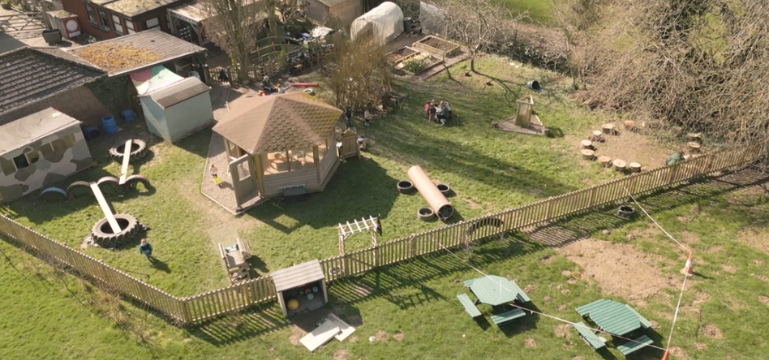
The setting is known for its exciting and enticing outdoor environments. These have been thoughtfully developed over time with children’s interests and developmental needs being the main driver for change. The setting provides an environment where children feel their voices are heard and have the freedom to explore, make choices and become confident, creative independent learners.
Practitioners work together to realise this ambition. Every practitioner encourages children to make their own choices and take charge of their learning. They do this by following a child’s lead and adding teachable moments to their play. The setting is led by a dedicated and reflective setting manager, experienced leaders, enthusiastic practitioners and a committed responsible individual supported by a voluntary committee. Together, they bring a wealth of knowledge care and passion to create a warm, welcoming and enticing environment for children.
Context and background to the effective or innovative practice
The vision for the setting is for all children to become confident creative independent learners. In 2022, leaders attended Local Authority training on schemas.
The training highlighted the importance of providing opportunities for children to engage in schematic play. Supporting schematic play has become a key part of their approach to implementing their vision to provide the best possible developmental experiences for all children.
Schemas are patterns of repeated behaviours that children use to organise their experiences and develop an understanding of their environment. Through these patterns, children make sense of new information while also building on their existing knowledge and understanding. Practitioners notice that children often focus on a particular area of interest and repeat actions to explore and develop their understanding.
Through training, adults know that this repetition helps children to test cause and effect, develop spatial awareness and problem-solving skills. By carefully observing these patterns throughout children’s play practitioners plan the enabling environment and experiences on offer, supporting learning aligned to a child’s schema.
Description of nature of strategy or activity
At Berriew Pre-school, adults have fully embraced the non-maintained curriculum and place a strong emphasis on meeting the needs of every child. This is achieved through a carefully planned learning environment, providing engaging experiences with an enabling adult.
Leaders understand that enabling adults play an important role, so it is crucial to discuss and reflect as a team. The pre-school leader invests time to research schemas and consistently shares information with the team through regular meetings and professional development opportunities. Adults develop a thorough understanding of schemas and schematic play. This ensures that all adults observe children effectively and identify key information about their play and learning. Adults recognise the types of behaviours that children demonstrate and understand what children may be exploring through these behaviours.
For example, a child who enjoys spinning wheels, riding bikes, twisting ribbons or turning taps may be exploring a rotational schema. Through these actions, the child may be developing their understanding of movement, shape and special awareness.
All adults observe children closely and identify emerging schemas. Children are then grouped according to similar schematic interests. This information forms the basis of the fortnightly planning. Planning focuses on enhancing the learning environment with appropriate authentic resources and designing engaging experiences that support the identified schema. For example, when adults identify a group of children exploring a rotational schema, they enhance the environment with resources such as whisks, ribbons, wool and rotational drills, gym balls and spinners. Adults also plan specific engaging experiences across the fortnight to extend this learning, such as parachute games, baking activities involving mixing, whisking and rolling, and exploring paint using salad spinners and rollers.
These additional resources and experiences quickly become embedded in the children’s everyday play provision, allowing them to explore and repeat their interests in a meaningful and sustained way. During the following fortnight, adults focus on another group of children with a different schematic interest. This approach ensures that planning is responsive, child-centred and rooted in careful observation, enabling practitioners to support children’s natural curiosity and deepen their understanding.
What impact has this work had on provision and children’s standards?
This switch in approach to focus on schematic play opportunities has a significant impact on the provision for children.
Practitioners recognise that when children are deeply interested and engaged in play and learning, their levels of attention and concentration increase. Adults confidently plan the environment based on the needs and interests of children. This ensures each child can learn in a way that suits their individual style. Practitioners continue to make thoughtful changes, adding authentic resources to core areas of provision to better support children’s schematic interests.
The schematic approach is now embedded in practice helping to build children’s confidence and deepen their understanding. As a result, all children can develop their learning in ways that are meaningful to them. They receive what they need at the moment they need it, which encourages curiosity and creativity within their learning. Children become confident explorers of their environment.
By recognising and following children’s schematic interests and valuing their play, Berriew Pre-school ensures every child develops a strong sense of belonging and self-worth. As a result, children’s well-being is exceptionally high. This approach underpins the setting’s vision of supporting children to become confident creative independent learners.
How have you shared your good practice?
The setting welcomes other early years settings and education professionals to observe children and share good practice on how they implement schematic interests and how this is embedded in planning and day to day practice.