Category: Uncategorised
Planning for increasing pupil numbers
One headteacher stated that, when the time comes to increase the number of pupils attending school, leaders will try to increase capacity safely by:
-
using classrooms that aren’t currently used as base rooms for year groups
-
continuing to stagger school starting times, end times, lunchtimes and break times to ensure that pupils do not gather in groups unnecessarily
This headteacher recognises that returning to full capacity will probably mean reducing social distancing guidelines.
Another school is planning to repurpose the school hall when all pupils return in September, as well as making use of unused teaching spaces. It is setting up room dividers in the hall. This means that, even as social distancing measures are eased, pupils will have more space and it will be possible to create smaller teaching groups.
A third school is planning a staggered approach for increasing pupil numbers during the first two weeks of September. For example, it plans to build up gradually the number of days that nursery and reception pupils attend. In addition, it intends to invite all Year 2 and Year 6 pupils in as full cohorts in the first instance. By the end of the second week, the headteacher expects the school to be operating at full capacity, and to look as it did before the period of school repurposing. Despite this, it will continue to limit mixing between groups, and staff will continue to adhere to social distancing measures.
Dealing with an outbreak of COVID-19
One headteacher described how the school successfully shut down one bubble following an outbreak of COVID-19 in the school. It followed Welsh Government guidance and its own pre-planned procedures to ensure that pupils from families where COVID-19 had been diagnosed were isolated and returned home. This enabled other pupils to continue with their learning.
Small groups, deeper relationships
Using small ‘bubbles’ for teaching, staff have more of a chance to listen to each pupil. Teachers feel that they know their pupils better and pupils can share their stories with staff as there is more time to talk. This has changed the school’s thinking about its approach to teaching. During the first four weeks back in September, each class will have a dedicated half hour of talk time, with each teacher focusing on a small group of six or seven pupils. During this time, teaching assistants will deliver what the teacher has planned, to the rest of the class.
Moving forward with the Curriculum for Wales
Many schools are keen to continue with their preparations for the Curriculum for Wales, despite recent setbacks. Leaders in one school have planned two in-service training days for the beginning of term where staff will complete joint planning based on the principles of Curriculum for Wales. One focus will be the curriculum lead working with key stage 2 teachers to bring foundation phase methodologies into use more widely in Years 3 to 6. The school has decided to stop ‘setting’ pupils by ability for literacy and numeracy from September. Instead, it will place all pupils in mixed ability, whole class groups that focus better on providing them with more holistic and integrated experiences.
Limiting the impact of future lockdowns
One school in a socially disadvantaged area acknowledges that parental engagement is key to the success of blended learning. Staff have invited parents into school to learn alongside their child. This encourages them to support their child at home. Staff spend time with pupils to ensure that they are confident at accessing digital learning platforms as independently as possible, as the vision is for pupils to be able to move through stages of blended learning seamlessly, should the need arise.
In another school, pupils have used digital platforms and other apps successfully through Hwb. Blended learning between classroom and home has become seamless. During face-to-face teaching time, staff present and explain homework, which had previously been distributed on a photocopied sheet, and will now transfer to online platforms.
To strengthen this approach and to reduce the impact on those less confident in their digital skills, the headteacher has planned training events for parents. During these events, parents log on to social platforms and have tours of the apps and facilities, including important safeguards that their children will be using. This will help the school in the event of further lockdowns.
Parental feedback
Parents have respected the school’s formal, but staggered drop-off and collection procedures and everything has run smoothly. Parents like the routines, the well-organised handover arrangements and visible staff presence, albeit from a suitable distance. The school is confident to continue these systems for September as all parents seem to understand them, and they work successfully.
Managing expectations
Leaders and staff at one primary school are working together to devise a model of blended learning for September. Planning for learning for each week will be based on setting ‘expectations for the teacher’, ‘expectations for the child’ and ‘expectations for the parent’. The headteacher feels that it is crucial to be up front with parents about what the school will expect from them and to gain ‘buy in’ for this during this preparatory phase. It is not their intention to lower their expectations of what children can achieve in their learning. They will ‘expect what we normally do, but with a lot of wellbeing wrapped around these expectations’. Leaders think they can manage to provide the whole curriculum, but will review this over time. They feel that, with fewer pupils in a class at any one time, teachers will be able to cover a lot of ground with small groups and individualised learning approaches. The week pupils are at home will be an opportunity for them to consolidate and extend this learning.
Encouraging engagement with distance learning
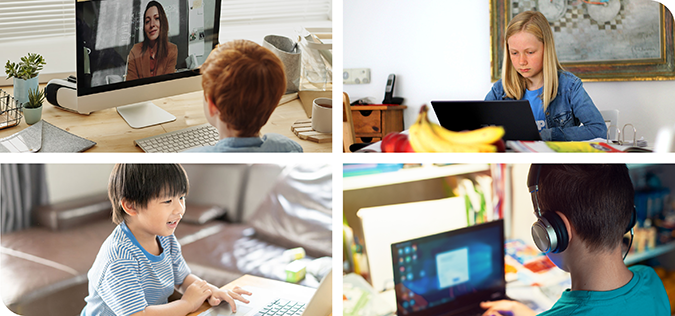
Knowing your pupils, families and communities well has proved key to effective engagement with distance learning. For example, one primary school provides video conferencing support for a few pupils who require additional support. The headteacher has delivered books to homes where she suspects that there are very few books. The school has invested in online tools and approaches that enable them to track and monitor the time pupils spend using them. The same school runs fun competitions and provides lots of practical activities to support parents. Following requests from parents, it has timetabled activities for the day. Although pupils don’t have to do them at a specific time, parents like this kind of support because it helps to provide a focus and some parameters within which to work. Pupils keep a chart of the activities they have completed on HWB. For example, if they have done 30 minutes of exercise on some platform, they note it to share with their teachers.
Supporting Welsh-medium education
In many Welsh medium schools, most pupils come from homes where Welsh is not spoken. The staff in one such primary school have tried to overcome this by providing pupils with learning activities that encourage them to use their Welsh as naturally as possible. The focus is on reading, understanding and, most importantly, speaking Welsh. Opportunities for pupils to develop presentations and create their own versions of Welsh songs and rhymes have been particularly successful. Pupils share their work with their teachers, who then provide feedback that focuses on the positive, and this has encouraged a relatively high number of pupils to take part.
Using reading apps
Pupils in one primary school can access an app to which the school subscribes that allows pupils to read books and complete quizzes on books they have read. This means that teachers can monitor to some degree what pupils read and gain some idea of their understanding and progress with their reading.
Encouraging remote learning
One primary school has managed to encourage most of its pupils to engage in learning to some extent, either online or through receiving paper work packs. Soon after schools closed, the school lent 60 laptops out to families without suitable equipment to engage with online learning. Staff also set up and manned a technical helpdesk to support parents to help their children access online learning on various platforms. The headteacher analyses levels of pupil engagement and staff are working to reach families where engagement levels are low, especially by supporting parents who are struggling or feeling anxious.
Planning blended learning
The headteacher of one primary school has produced a very comprehensive draft recovery plan that sets out clearly all aspects of how the school will evolve towards a new approach of blended learning. It includes logistical aspects and curriculum arrangements, and sets out the responsibilities of each member of staff, including how they will support home learning, for example “when I’m on site, what will I be doing?”.It includes what staff can expect from leaders to support them in their work and wellbeing. The next step will be to develop a communication strategy for parents. The school’s current plans for September include classes being split into groups of eight with home learning resources designed based on the skills and focus of their days in school. Teaching assistants and teachers who are shielding have been allocated to support this home learning. The school is designing its recovery curriculum using the areas of learning and experiences. Teachers will focus on wellbeing, languages, literacy and communication, mathematics and numeracy and ICT, with pockets of contextual learning and experience based on the other areas of learning. The approach is intended to ensure that teachers prioritise the development of knowledge and skills that children need to become resilient and high performing in the future rather than coverage.
A whole-school focus
One primary school recognised that parents with children of different ages find it challenging to deal with various topics at the same time. To try and overcome this, the whole school is focusing on one theme this term, with activities that can be differentiated for the age and ability of the pupils. This has the added bonus of encouraging collaboration between teachers, which may lead to enhanced appreciation of progression for pupils.
Online learning pods
One primary school has developed its online learning significantly. The school is organised into four learning pods. Pupils in each pod can access a series of planned learning shared on the school’s website. Teachers launch the week’s suggested activities on a Monday, usually with a video. The headteacher surveyed parents’ thoughts and responded to their view that the children wanted to see more of their teachers by developing video launches for each week’s activities and by changing from a set of tasks that had to be completed to suggested activities. Access to the school website and learning activities is simple, so most pupils engage in learning at home. The children are taught in their pods. The school has provided laptops for the very few pupils from disadvantaged families to ensure that they can take part in online learning.
Celebrating achievement virtually
The parents and children of one primary school appreciate the headteacher holding a virtual weekly celebration assembly for pupils. It is a familiar part of the pupils’ week in school before lockdown and helps to maintain some sort of connection with life before lockdown. The headteacher then delivers the certificate and pencil prize to pupils personally.
Providing feedback in real time
Ysgol Llannefydd is a small rural school in Conwy county. During the second national lockdown key workers’ children, who were attending school, and pupils who were learning at home followed the same structured timetable. The school used a video conferencing platform for informal catch-up sessions with children twice a week. During other lessons, staff responded to the tasks released in documents shared online at set times during the day in line with the timetabled lessons. For example, having learnt about Neil Armstrong, pupils created a job advertisement for the post of astronaut. The teacher followed pupils’ progress in real time on his screen, flicking between each pupil’s work and suggested improvements to their work as they went along.
Live-streaming pedagogy
At Ysgol Waunfawr, Gwynedd, nearly all pupils in key stage 2 engaged well with distance learning tasks. This included three live sessions per week for each class. In responding to a questionnaire, parents were particularly grateful to be able to see the teacher model how to approach tasks. For example, a teacher used a virtual whiteboard shared on her screen to explain the concepts of area and perimeter. She drew shapes on a squared background in real time and showed pupils how to find the sum of the perimeter, highlighting each side as she went along. Pupils could then watch her colouring the boxes to find the shape’s area. She then asked pupils to find the area and perimeter of other shapes provided in a shared document.
Meeting the needs of all pupils when learning from home
At Ysgol Plascrug, Aberystwyth, nearly all pupils responded well to tasks set online. Teachers felt that the introduction of live-streaming sessions contributed well to the engagement of pupils who like to learn visually.
In the foundation phase, pupils were invited to attend small group sessions online every day. From Year 2 up to Year 6, there was also a daily whole-class session before pupils broke out into smaller groups. These groups were based around pupils’ needs so that they could discuss work set at a level suitable to their needs. The headteacher felt that this helped to maintain pupil engagement. Teachers also posted online videos of themselves presenting tasks. Across the school, pupils received two tasks a day in addition to ongoing provision and support materials.
The headteacher led an online assembly on a weekly basis to maintain the ethos of the school. The school also held a web-based technological ‘drop-in’ session for parents to help with the use of Teams. The school offered a similar session specifically for refugee families held in Arabic.
Increasing engagement with distance learning
Leaders at Hywel Dda Primary School in Cardiff developed a comprehensive but simple way to analyse how well their pupils engage in the online learning that the school provides. In the first lockdown, they identified who did and did not take part in online learning, but this did not provide teachers with useful enough information to target support for those who could do with a little extra intervention. During the second school closure, leaders refined the system to take account of the percentage of tasks completed, highlighting five levels of engagement from those who did not engage at all to those who completed over 80% of tasks. The system also tracked those pupils who only completed learning tasks when they attended the school’s hub provision. This more detailed information enabled the school to identify and prioritise the pupils and families that needed the most support to engage with learning at home.
Mathematics and numeracy in the outdoors
During the pandemic, staff at Johnston CP School in Pembrokeshire continued to prepare for the implementation of the Curriculum for Wales in September 2022. The school used the time to evaluate how the four purposes aligned with their approach to teaching mathematics and developing numeracy skills. They identified ways to enhance their use of outdoor spaces to offer authentic learning experiences, make learning exciting and challenge themselves with regard how to introduce certain concepts. The aim was to plan more opportunities for pupils to construct, explore and discuss ideas in contexts that involved real-life problems. They worked with a National Park to develop a site adjacent to the school. They created areas for growing vegetables, a fire pit circle, built a bridge over a stream and created an orchard. This provided many rich numeracy activities. For example, pupils worked in groups to cut fabric membrane to stop grass from suffocating the newly planted apple trees, taking into account the required radius and working out the circumference.
Families help to influence teachers’ planning
At Ysgol Foel Gron in Gwynedd foundation phase staff wanted to make their online provision as effective and successful for as many pupils as possible. The staff sent a survey out to parents asking them about the resources they had at home to help their children. Teachers used the findings of the survey as an audit of what practical resources families had at home, for example paint, colouring pencils, paper, building blocks, glue and other resources. Teachers used this information to adapt the tasks accordingly. The school is very happy with the level of engagement. For example, nearly all pupils made ‘hearts’ out of toy building blocks during a science and technology activity. Staff also asked parents about their electronic devices to see how best to set work for the class. The school provided computers for those who were struggling to access the internet and sent out paper packs for those without printers.
‘Art Friday Focus’ encourages creative output during lockdown
Bigyn County Primary, Carmarthenshire, developed ‘Art Friday Focus’ as part of its distance learning offer. This allowed pupils to continue to contribute to an international project they had started working on in class that involved pupils in several other countries. The headteacher ran these sessions, which focused on discussing the work of a famous artist in a relaxed environment. The headteacher provided pupils with examples of work by the artists and, during the Friday sessions, pupils shared and discussed what they had produced. Many parents uploaded examples of the work to the school’s social media page, which encouraged engagement and contributed to creating a sense of community. This session also enabled teachers to take valuable planning, preparation and assessment time during lockdown.
Mapping out whole-school distance learning provision
From the first lockdown, leaders and staff at Ynyshir Primary in Rhondda Cynon Taf recognised that providing pupils and parents with tutorial videos, recording lessons and providing live lessons would help with progressing learners’ skills and understanding, particularly for those concepts that are difficult for parents to explain. From January, leaders mapped distance learning provision on a weekly whole school ‘live lessons and video planner’. This detailed when live lessons were taking place for individual classes and when live wellbeing ‘check in’ sessions with pupils were scheduled. They were mapped so that no two teachers or classes were online at the same time. This helped to reduce the challenges for families. There were agreed protocols in place for pupils and their parents when engaging in online learning.
Developing reading skills during lockdown
Pembroke Dock Community School in Pembrokeshire set up a programme to support pupils with reading, as it wanted to avoid pupils regressing while the school was only open to key worker and vulnerable children. It reassigned a group of support staff as ‘Reading Ambassadors’ to run the programme with around 200 pupils. These pupils were selected as they were not engaging fully with home learning or reading regularly at home. Each child received a one-hour weekly slot to come into school to work with a teaching assistant in a safe environment. Through this programme, all pupils were able to borrow school reading books and parents and pupils were given support in accessing online reading material. Many of the pupils were also provided with lunch and breakfast when they came to school. Where appropriate, the school also provided a breakfast pack to take home to have the following day.
Supporting Welsh-medium pupils learning at home
Ysgol Gymraeg Melin Gruffydd, Cardiff, made extensive use of live streaming and video clips to share guidance and instructions with pupils. Teachers were free to adapt how and when to run these sessions, varying the method depending on the context of the class and the task. Some teachers started live sessions with a whole class group, before continuing to work with small groups, supporting their learning. Others, often in the foundation phase, tended to start with small groups, and then bring the pupils together for a class session. This was a useful opportunity to review the learning, and to give pupils the opportunity to speak to their friends. Staff also recorded instructions bilingually and shared these with the pupils in video clips. This enabled non-Welsh speaking parents to support their child’s learning at home. To ensure that pupils were not completely isolated from their friends, staff organised regular virtual sessions for them to chat together informally or to work together on specific tasks such as creating presentations on a particular theme.