The effect of pupils’ opinions on the strategic direction of Ysgol David Hughes and the benefits to the wider community
Quick links:
- Information about the school/provider
- Context and background to the effective or innovative practice
- Description of nature of strategy or activity
- What impact has this work had on provision and outcomes for learners and/or their families?
- How have you shared your good practice in the school, the sector and beyond?
Information about the school/provider
Ysgol David Hughes is a bilingual secondary school that serves the south of Anglesey. There are 1,097 pupils at the school and 11.0% are eligible for free school meals. The vision of the school’s leaders is to provide the best and most relevant bilingual education for all pupils indiscriminately and to create an open and inclusive society that respect the views, aspirations and hopes of everyone who is part of the school community.
Context and background to the effective or innovative practice
The school was keen to strengthen pupils’ participation to be more meaningful and authentic. Following a visit to a Welsh-medium school in Swansea, a number of pupil committees were established, including the UNICEF committee. Leaders try to ensure that children’s rights influence all aspects of school life and feel that this has led to growth, not only in pupils’ confidence to voice their opinions but also in their sense of responsibility for ensuring the rights of children and adults. Leaders were also keen to take advantage of wider opportunities to create authentic contexts for participation and to promote cooperation at local, national and international level. This includes opportunities to work with a local science park and home for the elderly on technology projects to support the aging population, along with the British Council’s project on sustainability with other schools in Europe.
Description of nature of strategy or activity
Pupils felt that the school community needed to improve the way in which it demonstrated its commitment to being an inclusive school that celebrates diversity. The school had already begun its anti-racism journey and all the school’s staff had received relevant training. The UNICEF group came to the conclusion that representation on the corridors and in the classrooms needed to be improved. They worked on a project to create digital posters that celebrate the success of prominent individuals from different ethnic and religious backgrounds and sexual orientations, including individuals such as Betty Campbell, Tayce and Hanan Issa. A second group worked with the art department and a local artist to prepare art pieces that celebrate the success of prominent Welsh people, particularly women such as Tanni Grey-Thompson and Marina Diamandis. The UNICEF group also influenced the school’s anti-racism strategy and members of the group are part of the school’s Anti-racism Parents’ Forum. The views of pupils and parents on the forum have influenced aspects such as the way in which the school responds to racist comments from pupils. Members of the group also trained trainee teachers from Bangor University to ensure that they begin their career fully aware of their own role in creating a school that celebrates diversity and promotes inclusion.
In addition to responding to a variety of issues that arise during the year, the school council always focuses on one specific aspect in order to address it, based on data from questionnaires. A report from the School Health Research Network (SHRN) suggested that the school needed to address how pupils report bullying. Following a consultation period, the school council decided that this needed to be made easier for pupils. A ‘Learner’s Voice’ website was created, which includes a link where pupils can e-mail any concern they have if they do not feel confident to initiate a face-to-face conversation about it. There are also QR codes to the link on noticeboards around the school. The school’s main noticeboard also has anti-bullying posters in the eighteen languages spoken by the school’s learners.
The Welshness group works regularly with parents and members of the local community to promote the language. This includes organising a competition to decorate the windows of high street businesses for the St David’s Day parade and also encouraging businesses to display ‘We Speak Welsh / We’re Learning Welsh’ posters in their shops. Local businesses also support events that promote the Welsh language and days and celebrations at the school, for example Shwmae / Su’mae Day, the Urdd’s Peace and Goodwill Message, by offering prizes for various competitions. During parents’ evening, the Welshness group runs a stand to share information leaflets with parents to help them access useful apps and websites to help them learn Welsh. The Welshness group works independently and is solely responsible for organising these events. It has also contacted a television company to film an item on the group’s work for a television programme.
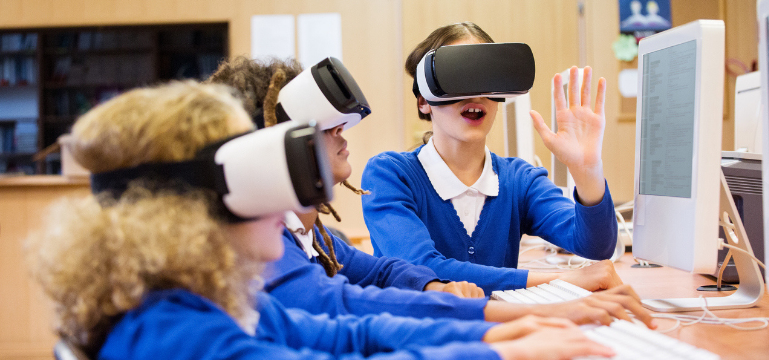
The school works closely with external agencies, particularly in the digital and technological world. Pupils are working with a local science park on a virtual reality (VR) project to support the aging population on the Isle of Anglesey. Pupils provide the residents of a local home for the elderly with an opportunity to use the VR to imagine that they are cycling along their childhood roads or walking on a local beach and hearing the sound of the sea and birds.
Following a visit by a group of pupils to Japan as a result of a Welsh Government Taith grant, a group of twenty Year 12 pupils worked with individuals from the science park to develop a computer game based on characters from Welsh and Japanese legends. This has given pupils an opportunity to develop new skills by working with experts in this field, but they have also understood that it is possible to work in the computer games industry while staying on Anglesey. In order to expand on this and ensure that a wider group of pupils benefit from the trip to Japan, pupils who visited the Hiroshima Peace Memorial Garden have shared their experience and the Eco group is working with a Japanese garden society to plan and create a peace garden.
What impact has this work had on provision and outcomes for learners and/or their families?
The opportunity to work with the science park has led to a number of significant outcomes for the school’s pupils. In addition to the opportunity to develop more specialised computer skills and learn how to use unfamiliar programs, pupils have also fostered a sense of pride in Welsh culture and have understood that there are opportunities to work in the technological world on global projects and be employed on the Isle of Anglesey. Some pupils have forged links with local/international computer game companies, and secured opportunities for work experience.
The school has taken advantage of the opportunity to foster the awareness of pupils and their families of the importance of the Well-being of Future Generations Act 2015 and to raise awareness of the aging population – particularly on Anglesey, as in Ōsakikamijima in the Hiroshima province. The bike and virtual reality goggles projects have led to further opportunities; for example, Year 7 pupils are using artificial intelligence to create robots that would support the elderly with daily tasks in their homes. The work of bridging the generations and creating a space for young and old to socialise and learn from each other has provided wider opportunities to create authentic contexts for participation and to promote co-operation.
The Parents’ Anti-racism Forum group has empowered parents and families to influence the school’s policies and procedures. The work of the UNICEF group and the school council has strengthened pupils’ participation and helped them to lead and initiate action in response to a whole-school priority.
The Welshness group has succeeded in increasing the number of diverse opportunities for pupils to participate in social events through the medium of Welsh, whether it be a gig, a baking competition or celebrating Welsh Music Week. It has also promoted the Welsh language in the town of Menai Bridge and sparked interest and enthusiasm for celebrating the language throughout the year. The school’s parents and families have taken advantage of the guidance on how they can develop their Welsh language ability.
How have you shared your good practice in the school, the sector and beyond?
- Isle of Anglesey Council has decided that all secondary schools should work on a project similar to the virtual reality project following our success.
- Members of school councils from Anglesey’s secondary schools have met to share ideas.
- The UNICEF group’s anti-racism work was shared in a ceremony by Peace Schools in Wales at the Llangollen Eisteddfod.