Teaching and Learning Science: Teaching for understanding in science classrooms
Executive summary
This thematic report examines the quality of teaching and learning in science in primary, secondary and all-age schools in Wales. It evaluates how well schools are developing pupils’ scientific knowledge, understanding and enquiry skills as part of the Science and Technology Area of Learning and Experience (Area) within the Curriculum for Wales for the 7-16 age range. The report considers the effectiveness of curriculum design, teaching, assessment and leadership, and how well schools support progression in science across phases. It also explores pupils’ attitudes towards science and how well they apply their learning in authentic contexts.
The report highlights examples of effective practice in the primary and secondary phases, where schools have developed coherent curriculum plans, strengthened subject expertise and supported pupils to deepen their understanding of scientific concepts over time. However, across the schools visited, the quality of provision for science is inconsistent. In too many cases, weaknesses in curriculum design, teaching and assessment limit pupils’ progress, particularly in developing secure conceptual understanding and scientific reasoning. Arrangements to support progression between the primary and secondary phases are often underdeveloped, leading to repetition, gaps in learning and uneven challenge.
This report evaluates four key areas:
- Science in the primary phase: A majority of primary schools are increasingly ambitious in their approach to science and provide pupils with engaging, practical learning experiences that foster curiosity and enjoyment. In the strongest practice, leaders have developed clear progression models that balance enquiry with the explicit teaching of scientific knowledge and provide meaningful real-world contexts, often through partnerships with industry and the community. However, in a minority of schools, science does not have a sufficiently high status within the curriculum. Over-reliance on thematic or enquiry-led approaches, without clear planning for conceptual progression, results in pupils completing activities without fully understanding the scientific ideas underpinning their work. Assessment and tracking of pupils’ scientific understanding are often underdeveloped, making it difficult for leaders to evaluate progress over time.
- Science in the secondary phase: In most secondary schools, curriculum plans are structured around disciplinary approaches to biology, chemistry and physics, supporting appropriate coverage and examination preparation. Where teaching is strongest, teachers use secure subject knowledge, effective modelling and questioning to develop pupils’ conceptual understanding and scientific reasoning. However, in a minority of schools, weaknesses in planning mean that learning is not sequenced clearly enough to develop pupils’ knowledge and skills systematically over time, particularly in Year 7 to Year 9. Limited curriculum time, staffing challenges and inconsistent collaboration with primary schools contribute to variability in pupils’ experiences and progress.
- Understanding progression in science: Across both phases, schools are at different stages in developing a shared understanding of progression in science. In the strongest examples, leaders use collaboration documents and shared expectations of progression to support continuity, revisit key concepts and address misconceptions systematically. However, in a majority of schools, progression is not planned securely enough. Teachers often address misconceptions reactively rather than anticipating them through curriculum design, and assessment does not consistently capture how pupils’ understanding deepens over time.
- Leading and improving science: Effective leadership is a key factor in securing strong science provision. In schools where leaders prioritise science, protect curriculum time and invest in subject-specific professional learning, pupils benefit from more coherent curricula and stronger teaching. However, in many schools, the monitoring and evaluation of science focuses too heavily on provision rather than its impact on learning. Challenges in recruiting and retaining specialist science teachers, particularly in Welsh-medium settings, continue to affect provision.
Across the schools visited, the strongest teaching in science shares a number of common features. These features reflect the ways in which teachers support pupils to develop secure conceptual understanding and apply their learning over time. They are summarised below.
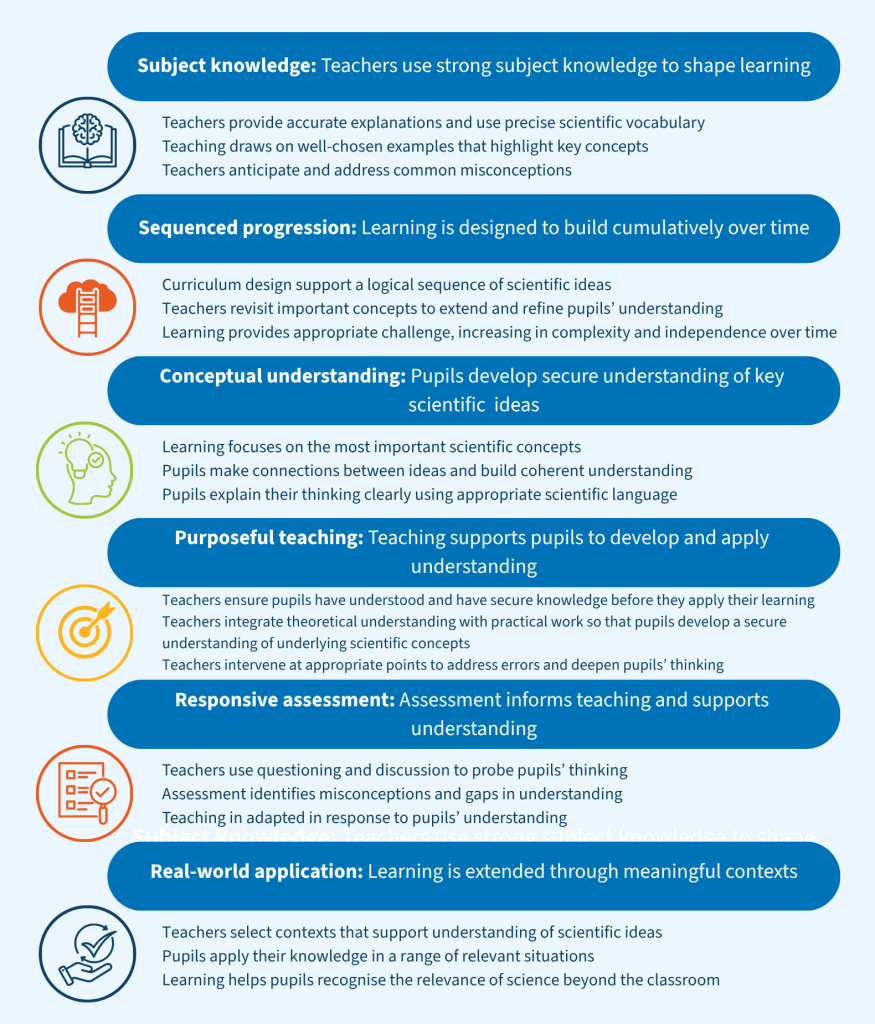
This report makes recommendations for schools, local authorities and school improvement services, and the Welsh Government. These recommendations focus on strengthening curriculum planning for progression, improving the quality of teaching and assessment, developing leadership capacity in science, and addressing workforce and professional learning challenges to ensure that all pupils in Wales experience high-quality science education.