Effective Practice Archives - Page 45 of 66 - Estyn

Improvement Resource Type: Effective Practice


Improvement Resource Type: Effective Practice


Information about the school

Ysgol Gynradd Sant Curig is situated in the centre of the town of Barry in the Vale of Glamorgan.  Welsh is the main medium of the school’s life and work.  There are 425 pupils between 3 and 11 years old on roll, including 55 nursery age pupils.  The school has 16 single age classes, including two classes for nursery children.

Over the last three years, around 11% of pupils have been eligible for free school meals.  Around a quarter of pupils come from Welsh-speaking homes.  Very few are from ethnic minority backgrounds. The school has identified around 14% of its pupils as having additional learning needs.

Context and background to the effective or innovative practice

Ysgol Sant Curig is a highly caring community, where most pupils make sound progress and achieve well.  Nearly all pupils’ standards of wellbeing, behaviour and attitudes to learning are excellent.  They show high levels of motivation, interest and pride in their work. 

The school has forged an excellent working relationship between pupils and staff, which contributes to an effective learning environment.  The school has developed a number of strategies that support and develop pupils’ confidence, independence and resilience to overcome challenges in their learning and nurture a positive culture towards learning, for example by establishing the ‘Clwb Dechrau Da’, ‘Clwb Cwtsh’, ELSA sessions to develop pupils’ emotional wellbeing, and ‘Cŵl wedi Cinio’. 

The school believes strongly that all pupils need to experience sound mental wellbeing, resilience and self-confidence in order to reach their full potential and grow to become principled citizens and healthy, confident individuals.  Therefore, the full range of wellbeing activities is given priority when planning the school’s strategic direction, and the pupil’s voice is given a prominent place in the school’s work.

Description of the nature of the strategy or activity

The school’s staff identify individuals who would benefit from purposeful support.  The ‘Dechrau Da’ and ‘Clwb Cwtsh’ clubs support and nurture pupils, and provide them with a positive and stable start.  Staff ensure opportunities for them to discuss their worries and ensure that they are prepared fully for the day ahead.  This is implemented on a ‘drop-in’ basis before the start of the school day.  ‘Clwb Cwtsh’ provides nurture sessions, in which pupils are given an opportunity to develop life skills, such as cooking, sewing and eating together around the table.  Opportunities are also provided to improve their self-confidence, develop tolerance and social skills.  Parents are invited to some sessions with their children. 

The scheme to develop pupils’ emotional wellbeing (ELSA) provides specific support for children through difficult times in their lives, and develops their emotional literacy skills.  ‘Cŵl wedi Cinio’ sessions are provided to promote mindfulness among all pupils from nursery to Year 3.  The aim of this intervention is to provide a calm period for pupils after a busy lunchtime to prepare for the afternoon learning session.

What impact has this work had on provision and learners’ standards?

Pupils’ wellbeing and attitudes to learning are excellent.  Pupils show high levels of motivation, interest and pride in their work.  Nearly all take part in their activities enthusiastically and concentrate well.  As a result, nearly all pupils do their best and achieve well.

How have you shared your good practice?

The above practice has been shared with the Welsh-medium schools in the Central South Consortium (CSC) as part of the ‘Cadwyn Cynradd’ training programme.



Improvement Resource Type: Effective Practice


Information about the setting

Cylch Meithrin Crymych is a Welsh-medium setting. It meets in a self-contained cabin on the grounds of Ysgol y Frenni in the village of Crymych, in Pembrokeshire local authority. The setting provides education five mornings a week, between 9.00am and 11.30am during term time.

The setting is registered to admit up to 18 children at any given time, and admits children between two-and-a-half and four years old. At the time of the inspection, four of the three‑year‑old children receive funded early years education.

Nearly all children come from white British backgrounds and around half speak Welsh as their first language. There are currently no children with additional learning needs.

The setting employs three qualified practitioners, including the leader. The leader began in post in October 2006.

Context and background to the sector-leading practice

The welcoming ethos at Cylch Meithrin Crymych ignites a strong sense of belonging among the children. One of the setting’s strengths is that it has forged close links with various partners in the local area. This ensures that children have a sound understanding that they belong to a wider community, in addition to the setting’s community. Best practice identifies how the setting maintains a close relationship with the community to provide engaging and stimulating provision to develop children’s oracy skills, in addition to promoting their social skills and Welsh identity. This has an excellent effect on children’s wellbeing. Children are given regular opportunities to go out into the community, and members of the community are welcomed to the setting regularly.

Description of the nature of the sector-leading strategy or activity

Cylch Meithrin Crymych takes advantage of every opportunity to work with the local community. Forging this relationship is at the heart of practitioners’ planning. Practitioners make valuable plans to visit the village shops regularly, for example the bakery, the butchers, the health food shop, the electrical shop and the cafe. Children are given opportunities to ask for things and buy them. This also develops their oracy skills and their awareness of using money for a real purpose beneficially. Occasionally, sessions include visiting one particular place. For example, practitioners organised a visit to the bakery, where children learnt about the work that is done there, tested the produce, and baked and decorated cakes to take home. Practitioners take advantage of this golden opportunity to show children that many goods and services are available locally, and how buying locally promotes sustainability and is beneficial to their local area.

The setting visits other local services and businesses, such as the fire station, the first responder, the police and the health centre regularly. A notable aspect is the way in which the setting visits people who have links to the setting during periods of illness. This develops children’s empathy very well. A Christmas concert is held in the village chapel every year, and parents and the wider community come together to celebrate with the setting. The setting also maintains links during this time of the year by singing carols in the community, which enriches children’s understanding of traditions in a wholly relevant way.

Members of the local community are invited to the setting often. Effective examples of this are to conduct story, singing and craft sessions with Merched y Wawr and Clwb Gwawr, workshops with individuals from the fire service, and a visit from the lollipop lady to discuss road safety.

What impact has this work had on provision and learners’ standards?

The regular practice of providing rich learning experiences for children out in the community engages children’s enthusiasm exceptionally well. This work stimulates beneficial discussions, which enable practitioners to develop children’s oracy skills effectively and naturally. They are given excellent opportunities to develop their numeracy skills in real-life situations, for example by using money to buy fruit. Extensive use of the community and visitors makes children aware that they belong to a wider community. This enriches their understanding of their local area and the world around them exceptionally well.

How have you shared your good practice?

Good practice is shared in cluster meetings that are held every term within the authority. Practitioners are invited to visit the setting.

Improvement Resource Type: Effective Practice


Information about the setting

Cylch Meithrin Ynyshir & Wattstown is registered to take up to 24 children.  The setting provides sessional and full day care for children aged from two to four years.  It provides funded early years education, Flying Start provision and the funded child care offer as well as providing places for fee-paying children. 

Nearly all children come from homes where English is the main language spoken.  The setting’s aim is to give children the best opportunities to reach their full potential in a high quality, nurturing and caring environment.

Context and background to the effective or innovative practice
 

The setting used to offer a traditional snack time routine that involved serving children as a whole group, using plastic cups and plates, and offering no choice of food or drink.  From their observations, practitioners recognised that this routine had a negative effect on the children’s 

wellbeing and behaviour, and did not promote their independence or allow them to make choices.  They recognised that it was not appropriate to expect such young children to sit for prolonged periods at the snack table.  They realised that very few children had experience of sitting together to share at the table informally to chat and share food and drink.  This led the team to develop a ‘rolling snack’ where children could access refreshments independently throughout the session. 

The setting registered for the Healthy and Sustainable Pre School Scheme.  This developed practitioners’ understanding about the benefits of modelling healthy lifestyles.  Acting on information from training, practitioners created a varied snack menu, purchased real crockery and glassware and began using real cutlery.  This provided valuable opportunities for children to experience and use real, good quality resources and learn to look after them carefully.   

The setting involved families by offering parent engagement sessions which provided a wealth of information about the advantages of healthy snacks and lifestyles.  This has had a positive impact on the choices they provide at home.  Many parents have participated in cooking sessions with their children at the setting.

Description of nature of strategy or activity

Children choose when to have their snack and serve themselves independently.  

Practitioners model how to use the snack area carefully, so that children know what to do.  They have high expectations of the children and, as a result, the children develop a wide variety of skills effectively.  

  • Children learn about the importance of personal hygiene.  Most children understand the routine well and wash their hands independently before they take their snack.  
  • Nearly all children make confident choices when they select food, appropriate crockery and cutlery and then serve themselves.   
  • They learn to take turns, wait patiently and chat to their peers and to adults while they eat and drink. 
  • Most children become proficient in using tongs, spoons and knives whilst serving, scraping, pouring and spreading.  This develops their fine motor physical skills well.
  • Nearly all children learn to use knives and scissors carefully and safely for cutting, chopping and spreading.  
  • Practitioners encourage children to be adventurous and take risks to try new foods, from their own and from other cultures.
  • Nearly all children learn to take responsibility for clearing up and recycling any food left over.

Once this routine was established, practitioners moved on to plant, grow and harvest herbs and vegetables with the children, which they cooked and used at snack time.   

Practitioners have evaluated their work and identified next steps, to build on their good practice.  They aim to:

  • compost our recycled food waste, so the children understand the full cycle
  • enable children to wash and dry their dishes to encourage further independence

What impact has this work had on provision and children’s standards?

Practitioners’ observations show that children’s behaviour, concentration, speaking and listening skills, personal and social skills, and physical skills have improved considerably.  Many achieve above the expected outcomes for their age in personal and social development as a result of their experiences.  Children enjoy their snack and use the area responsibly.  

How have you shared your good practice?

Many practitioners from across the local authority have visited the setting to observe the snack time routine.  Local authority officers recognise the provision at snack time as an example of good practice.

Improvement Resource Type: Effective Practice


Information about the school

Bishop Hedley Catholic High School is an 11-16 comprehensive school in Merthyr Tydfil.  There are 519 pupils on roll.  These figures are slightly lower than at the time of the previous core inspection, as the school no longer has a sixth form.  The school receives pupils mostly from seven associated Catholic primary schools.  These schools cover a wide area including Merthyr Tydfil, Merthyr Vale, Gurnos, Hirwaun, Aberdare, Ebbw Vale, Brynmawr, Tredegar and Rhymney.  The school welcomes pupils of all faiths and those with no faith background.  The percentage of pupils eligible for free school meals is 20.6%, which is above the national average of 16.4% for secondary schools.  The school has about 26% of pupils on the special educational needs register, which is higher than the national average of 22.9% for secondary schools.  About 1% of pupils have a statement of special educational needs, which is lower than the national average of 2.2%.  Around 29% of pupils come from minority ethnic groups and about 27% of pupils come from homes where English is not the first language.  Almost no pupils speak Welsh at home.  The interim headteacher took up post in 2018.  There is an interim deputy headteacher, and three assistant headteachers.  The school is currently a curriculum pioneer school and is working with the Welsh Government and other schools to take forward developments relating to curriculum reform.

Context and background to the effective or innovative practice 

As a Pioneer Curriculum School, Bishop Hedley took the opportunity to innovate and take managed risks.  It believed that pupils were not thinking holistically as they were unable to transfer skills routinely and many were not willing to take a risk, not only in their learning, but in day-to-day living.  The ‘Enrichment programme’, named ‘Opening Minds’, was born from a desire to address these issues, and was loosely modelled on both the Welsh and International Baccalaureate.

As the school began to think about the New Curriculum and adapt its approach, it became apparent very quickly that pupils needed to adapt their approach too.  The school was mindful of making the curriculum relevant for learners who would be leaving to make their way in a world that does not exist yet.  Significant planning and preparation time was allocated in the summer term of 2017, allowing for the ‘Opening Minds’ launch in September 2017.  This programme was developed by the ‘Pioneer Team’, led by the subject leader for geography in 2017, and further enhanced in 2018.

Description of nature of strategy or activity

The challenges of the previous curriculum highlighted the need to improve the enrichment opportunities available for pupils, in particular for pupils to have meaningful opportunities to consider and gain expertise in the skills and attributes that they will need and want to possess as they embarked on the next stage in their journey of life. 

The innovative Enrichment programme addresses the development of these important life skills and supports the introduction of the new curriculum for Wales through a whole-school experience for the school’s pupils.   It is an annual two-week programme that provides pupils with opportunities to explore and develop their individual skills and interests.

The programme includes seven key areas, all of which support the philosophy of ‘Successful Futures’ (Donaldson 2015) and are built around addressing the four core purposes.  Through exploring each of these key areas, pupils also develop the essential ‘Habits of Mind’ (Costa and Kallick 2008) that underpin the programme areas:

  • Mission
  • Life skills
  • Growth mindset
  • Critical thinking
  • Community service
  • Health and wellbeing
  • Creativity

The programme offers pupils a variety of opportunities, both in school and in the community, with workshops led by staff and external providers.  Pupils are encouraged to engage in activities that they have not done before or fine tune a skill that they are not proficient at, with the aim of developing resilience and independence.  For example, they can attend literacy workshops, an international language and cultural awareness day, outdoor pursuit activities and local and London theatre events.  The community service element is particularly impactful, where the school encourages pupils to participate in schemes both within and beyond school such as beach litter picking.  These activities help pupils to develop their social skills by challenging their thinking and developing greater understanding of the importance of tolerance, respect for others and celebrating diversity.  The fortnight is also an opportunity for key stage 4 learners to address some of the demands of the Welsh Baccalaureate.  An addition to the programme for 2018 was recognition for undertaking leadership roles under a ‘Hedley Pledge’ scheme, and the involvement of key stage 2 pupils in several activities to strengthen transition arrangements.

References

Donaldson, G. (2015) Successful Futures: Independent review of curriculum and assessment arrangements in Wales. Cardiff: Welsh Government. [Online]. Available from: http://gov.wales/docs/dcells/publications/150225-successful-futures-cy.pdf

Costa, A. and Kallick, B. (2008) Learning and Leading with Habits of Mind: 16 Essential Characteristics for Success. ACSD, Virginia, U.S.A.

What impact has this work had on provision and learners’ standards?

Since its introduction, ‘Opening Minds’ has eased transition and enabled pupils to secure a sense of success in many new areas.  A notable benefit of the programme is further strengthening the caring and inclusive Christian ethos of the school, with recognition of and provision for pupils’ wider skills, as learners take successful ownership of their development.  Other benefits include:

  • improved wellbeing and attitudes to learning, with pupils’ routine use of multiple skills outside of and across curriculum areas
  • increased and improved work with outside agencies to widen pupils’ experiences, further engage and motivate them
  • at key stage 4, improved outcomes in the Welsh Baccalaureate Qualification

How have you shared your good practice?

As a Pioneer School, Bishop Hedley has hosted many visits from other schools and interested parties.  The school has also participated in a number of national and local conferences, and presented to the Welsh Government and local consortium.  The school also shares the Pioneer work amongst the consortium School Improvement Group.

Improvement Resource Type: Effective Practice


Information about the school

Glenboi Community Primary School is situated on the outskirts of Mountain Ash in the Rhondda Cynon Taf local authority.  There are currently 134 pupils on roll, including 23 pupils who access full time nursery provision.  There are four mixed aged mainstream classes and a social, emotional and behavioural difficulties unit, which provides specialist provision supporting learners to access mainstream education.

Around 65% of pupils are eligible for free school meals, which is significantly higher than the national average of 18.4%.  The school has identified 44% of pupils with additional learning needs.  All of the pupils come from English speaking homes.

Context and background to the effective or innovative practice

The school has been consistently recognised as a caring and nurturing learning environment where pupils are effectively supported to thrive both academically and in terms of their wellbeing.  Key to this has been the strong focus on parental engagement, which has had a very positive impact on pupils’ attitudes to learning, pupil outcomes and wellbeing.

Description of nature of strategy or activity

At the heart of the school’s approach to developing effective links with parents is a shared understanding by the whole school community about the impact that effective partnerships have on pupils’ attitudes to learning, pupils’ outcomes and wellbeing.  Parental and family engagement has been a school improvement priority in the school for four years.  Integral to the success of parental engagement has been the appointment of a highly effective Family Engagement Officer (FEO) who has put into place a number of strategies to promote family engagement and to help parents to support their children’s learning.

The FEO has taken a number of steps:

  • The FEO develops positive relationships with parents and families before pupils start at the nursery,by arranging home visits, which ensures a smooth transition into school.  She maintains these positive relationships and offers social and emotional support to parents and families in need.  She is also able to issue foodbank vouchers to vulnerable families.
  • The FEO works with the acting headteacher to lead a very effective Parent Council, who meet on a termly basis to discuss school improvement priorities, participate in learning walks and book scrutiny as well as providing an open forum to discuss any issues or concerns raised by parents.  This has been a very successful method of communicating important information about school priorities with all parents.
  • The FEO works with a number of external agencies to provide interventions which support parents to engage with their children’s learning , for example through FAST (Families and Schools Together – Save the Children), Families Connect, Happi Project, Impact Maths, Valleys Kids, and Family Learning.  She has also provided parenting courses.  Leaders have evaluated the impact of these strategies on improving outcomes for pupils.
  • The FEO monitors attendance on a weekly basis with the acting headteacher.  She contacts all families on the first day of absence and arranges meetings with parents to offer support if poor attendance becomes a concern.  Termly booklets are sent home to advise parents of their child’s individual attendance and the procedures to follow if they are absent from school.  The FEO works closely with the Education Welfare Service to monitor the attendance and wellbeing of all pupils.  At the end of each half term, 100% attendance is celebrated in assembly and pupils receive certificates and are entered into a raffle.  These strategies have ensured that attendance in Glenboi has been at least comparable or better than that of similar schools for the last two years.
  • The FEO has ELSA (Emotional Literacy Support Assistants) training to promote the emotional wellbeing of children and young people.  Other training incudes learning about children’s development, increasing resilience and helping to raise attainment and training on ACEs (Adverse Childhood Experiences).  These help provide wellbeing interventions for those children who are identified as needing additional support across the school.
  • As Deputy Safeguarding Officer the FEO liaises with externals agencies such as Resilient Families and the children’s services of the local authority.  She co-ordinates referrals to agencies such as speech and language, neurodevelopment and the MASH (Multi-agency safeguarding hub) team.  She also attends case conferences and core group meetings to support vulnerable children and their families.

What impact has this work had on provision and learners’ standards?

There is a very positive relationship between the school and its families, based on trust and respect, and this has had a positive impact on pupil outcomes, attitudes to learning and wellbeing.

Parent questionnaires state that 100% of parents are satisfied with the school, 100% of parents feel well informed about their child’s progress and 99% of parents feel that the school communicates well with them.

Parents’ confidence to support their children’s learning at home has improved.  Family engagement has been identified as a strong aspect of the school.

How have you shared your good practice?

The school is sharing its good practice with parents, governors and the local community through monthly newsletters, the school website, and through social media.  It promptly disseminates the minutes of governing body, Parent Council and Friends of Glenboi meetings.  Good practice is also shared via regular school-to-school working within the cluster and school improvement group.

Improvement Resource Type: Effective Practice


Information about the school

Ysgol Llwyn yr Eos is in Penparcau on the outskirts of Aberystwyth in Ceredigion.  There are 259 pupils between 3 and 11 years old on roll, including 39 part-time nursery age pupils.  They are divided into 13 classes, four of which are special educational needs resource base classes.  The school admits pupils with specific needs from various areas across Ceredigion.  Pupils in the resource base classes have a range of social, medical and communication needs.  The school also has a nurture base for pupils with emotional and social difficulties and houses a key stage 2 pupil referral unit that integrates into the mainstream setting.

The average proportion of pupils eligible for free school meals over the last three years is around 31%.  This is significantly above the national average of 19%.  The school has identified 40% of its pupils as having additional learning needs, which is significantly above the national average of 21%.

Ysgol Llwyn yr Eos provides a caring and highly inclusive environment for all pupils to succeed through creating a strong whole-school ethos placing wellbeing at the centre of its work.

Context and background to the effective or innovative practice

The background of the school presents a number of opportunities and challenges, including a history of low baseline assessments and generally a high intake of pupils from other schools with emotional and behavioural difficulties, particularly in key stage 2.

The school addresses these challenges through a common set of shared values, which inform a co-ordinated and systemic approach to learning and a clear overall vision of success.

These include:

  • intensive early intervention procedures
  • a holistic / whole school approach to the curriculum
  • targeting key strategic areas for the biggest overall impact
  • challenging any perceptions of innate ability and ensuring the highest expectations for all pupils

Every school defines measures that demonstrate how its vision and aims are to being achieved.  The priority at Ysgol Llwyn yr Eos is ensuring that all pupils are ‘in a place to learn’.

Description of nature of strategy or activity

Every pupil at Ysgol Llwyn yr Eos accesses a bespoke curriculum tailored to their specific needs.

The underlying principles of this provision are that:

  • All learning is ‘context specific’ and part of a continuous evaluation process 
  • There is clear understanding that all assessment should be in place to support pupils’ learning
  • This is a ‘needs led’ process that focuses on the ‘whole child’

The effective use of assessment in identifying the next step in a pupil’s learning is facilitated effectively.  For example, subject and key stage co-ordinators meet formally every two weeks to use pupil information to plan the next step forward.  Informal meetings involving all stakeholders are held on an ongoing basis and complement this process.  From these discussions, in direct response to their identified needs, pupils are signposted to particular teachers, specific lessons and intervention groups.  Correct understanding of pupil achievement and attainment is crucial.  The school’s processes allow for an ongoing ‘tweaking’ of provision driven by a mutual understanding of each pupil’s strengths and areas for improvement.  Support for pupils is modified regularly and can be adapted and refined at short notice.  Specific diagnostic tools used to track and monitor pupils’ progress, wellbeing and behaviour are utilised effectively.  These include:

  • the informed use of teacher assessments, combined with a strong knowledge and understanding of pupils’ specific needs, including their cognitive and emotional development and appropriate background information; this reflects the importance of empathic as well as statistical driven judgements
  • ongoing profiling for all pupils, which assesses social, emotional and behavioural development and measures progress through a variety of developmental strands; this information is used to create realistic child-centered profiles that can be shared and acted upon by all stakeholders to shape future nurture provision as relevant
  • use of a particular tracking system piloted by Ysgol Llwyn yr Eos, that reflects all progress however minimal, and factors in the amount of time the pupil has spent at the school; this proves particularly useful given the number of latecomers accepted into both key stages on a termly basis at the school

Staff in both mainstream classes and resource bases use these holistic processes successfully and creatively to assess impact and inform future provision.  This includes the effective deployment and use of staff expertise across the whole school and the flexible teaching arrangements applied throughout all classes.

Key points:

  • Careful monitoring of progress ensures that pupils receive additional support only for as long as is needed for them to make sufficient progress.
  • It is important that all staff acknowledge a shared commitment to promoting continuous and sustainable improvements.
  • It is essential that every marginal gain is noted and celebrated.  Progress at the school is an accumulation of small victories that are shared and valued by all stakeholders, creating a momentum that builds on the existing culture of achievement and success.

What impact has this work had on provision and learners’ standards?

Monitoring processes demonstrate that most pupils, including those with additional learning needs, make good and often very good progress from their differing starting points as they move through the school.  This judgement is supported by quality assurance at the school and demonstrated through tracking procedures, teachers’ assessments and national test results.

The successful blend of teaching strategies has an extremely positive effect on pupils’ achievement and wellbeing.  Most pupils are confident, resilient learners with high levels of self-esteem. They enjoy school and show very positive attitudes to their learning.  The direct correlation between wellbeing, progress and success is also reflected in the following ways:

  • the continued closure of the gap between the performance of boys and girls in recent years
  • high levels of pupil attendance on a sustained basis
  • the fact that there have been no exclusions at the school for 17 consecutive years

How have you shared your good practice?

The school has shared good practice on a local, county and national level through encouraging other schools and settings to visit to observe this provision in practice.  The school demonstrates to other educational providers how to link the school practice recorded in this study successfully with national wellbeing priorities, such as the ACEs initiative and ‘Attachment Awareness’.  The school presents its findings to multi-agency audiences, including teaching practitioners, senior level leaders and strategic managers across Wales.

Improvement Resource Type: Effective Practice


Information about the school

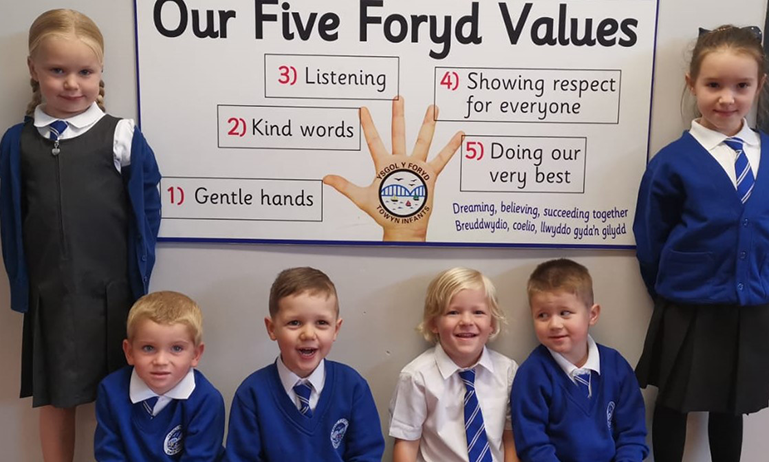
Ysgol y Foryd Infant School is in Kinmel Bay within Conwy local authority.  The school has 225 pupils between the ages of three and seven, including 50 part-time pupils in the nursery.  There are eight classes at the school.

The average proportion of pupils eligible for free school meals over the last three years is around 29%.  This is higher than the national average of 19%.  A very few pupils are from a minority ethnic background.  The school has identified 35% of its pupils as having additional learning needs, which is well above the national average of 21%.

The acting headteacher took up her post in September 2017.

Context and background to the effective or innovative practice

Research shows that effective formative assessment is one of the most important contributors to success in summative assessment.  This is because learners have a clear idea of what excellent work looks like and what they need to do to reach this standard.  Assessment for learning helps in making understanding and knowledge, as John Hattie describes it, ‘more visible’.

Ysgol y Foryd has researched and trialled many different aspects of assessment for learning strategies and over time has developed a consistent, progressive and innovative approach that works for the school.

Description of nature of strategy or activity

The effective use of assessment for learning strategies supports pupils’ progress and development as independent learners.  Based on the work by James Nottingham, all classes devise a learning pit with the pupils at the start of the academic year, as a way of teaching the pupils to face challenges and use mistakes as learning opportunities.

Pupils receive constructive feedback in order for them to understand what they need to do to improve their work.  A whole school marking policy that is simple but meaningful to all stakeholders has been the key to getting this right.  Pupils understand when they have done something positive and when they can improve on something by looking at the colour of teachers’ marking; pink for positive and green for growth.  Opportunity is then given immediately for pupils to improve their work.

All classes use ‘talking partners’ to enable pupils to work in pairs to discuss their learning and share ideas.  They are changed regularly to build confidence in speaking and listening.  ‘Talk partners’ encourage all pupils to talk and often identify misconceptions early. 

The school believes that pupils should be given ‘the power to learn’.  All staff decided upon six learning powers and devised character names and stories for each one.  The school developed one story at a time, starting with an assembly, followed by activities in each class to promote and reinforce the ‘learning power’.  Nearly all pupils refer to the characters when describing how they learned, for example ‘Gwen the gorilla gives it a go!’

Learning at Ysgol y Foryd is topic based and includes skills based focused weeks, including science week, woodland week and beach week.  At the start of every topic, teachers find what the pupils already know and the pupils contribute to the planning with ideas of what they would like to learn and how they can achieve this.  As the topic progresses, the teachers and pupils complete a learning journey display to demonstrate their new knowledge.  Pupil-led planning has resulted in interesting trips and visitors to the school and has increased pupil engagement with their own learning.

What impact has this work had on provision and learners’ standards?

As a result of the assessment for learning strategies being used consistently, pupils are independent in their learning and can identify what they need to do in order to improve their work.  They are confident in choosing their own level of challenge.  A positive result of the pupils’ ability to reflect on and improve their own learning is, for example, the increase in the number of pupils attaining outcome 6 in personal and social development in the foundation phase.

The whole school ethos has changed as a result of the consistent approach towards assessment for learning.  Classes have a ‘growth mindset culture’ and pupils’ ideas and opinions are valued.  Learning is built upon and not repeated, which ensures sound progression through the foundation phase.  Pupils are given constructive criticism, which enables them to ‘grow their brains’.

How have you shared your good practice?

The school shares its good practice with all stakeholder through meetings, open days, newsletters and Twitter.  An effective practice case study has been shared on the consortium’s ‘G6’ platform for schools in the region to read and share. 

Ysgol y Foryd are sharing good practice relating to assessment for learning across the consortium.  Lead teachers delivered presentations to over 100 schools and the headteacher presented to HLTA’s (higher level teaching assistants) and headteachers as part of the annual HLTA conference.

Improvement Resource Type: Effective Practice


Information about the school

Trinant Primary is in the village of Trinant, near Crumlin in the county borough of Caerphilly.  There are 153 pupils on roll, including 28 part time nursery pupils.  Pupils are taught in five mixed age classes.

Over the past three years, around 34% of pupils are eligible for free school meals.  This is well above the Wales average of 18%.  The school has identified around 30% of its pupils as having additional learning needs, which is well above the Wales average of 21%.

The headteacher took up her post in November 2011.

Context and background to sector-leading practice: Enriching Learning Experiences for pupils

Trinant Primary has a strong track record of improvement over time despite higher than average levels of free school meals and pupils identified as having additional learning needs.

The school’s motto ‘Stepping Stones to Success’ reflects the learning journey pupils undertake and that pupils and staff take different routes at different times, but all experience successes.  Central to the school’s vision is the concept that ‘we treat each other like our family’.  This results in everyone ‘going the extra mile’ and not wanting to disappoint or to let anyone down.  This is at the heart of the school and key to continued successful school improvement.  Staff believe in their pupils and encourage them to have aspirations beyond their close knit community.

Description of nature of strategy or activity

Staff and pupils fully explored the four core purposes of the curriculum for Wales and what the provision would look like in their classrooms.  The seven dimensions were explored with all stakeholders and current effectiveness was evaluated through RAG (Red, Amber, Green) rating.  Priorities for development were identified that involved significant cultural changes to the generally structured and often repetitive and predictable planning of topics.  Changes to the development of the curriculum within school were needed.  Pupils and staff collaborated on what they would like to learn, resulting in themes being democratically chosen in classes.  Using the areas of learning and curriculum subjects, pupils and staff collated activities to explore, identifying and tracking the skills that they would be developing.  Together staff and pupils co-constructed their own learning journey for that term; this was then shared with parents.  Every fortnight, pupils and staff reviewed the learning that had taken place and suggested activities for the following fortnight that fed into teachers’ flexible planning.  This process ensured that the learning ceased to become predictable and static and ensured that learning was driven by the enthusiasm of pupils.

Effective use of grants allowed for the creative and inspiring use of ‘hooks’ at the start of topics.  Pupils were hooked into their learning through a range of real-life experiences, ranging from crime scene investigators to entertainment critics reviewing live theatre performances.  These rich experiences instantly engaged pupils and helped to develop a culture of enquiry, innovation and exploration.  Pupils’ enthusiasm was harnessed and this fostered a willingness to be successful through the learning process.  Skills were then naturally transferred to other areas of the curriculum in a purposeful, seamless way so that there was a continuous journey of learning.  For example, group evidence bags were devised that allowed pupils to build on their previous learning and to use their collaborative, scientific and numeracy skills to solve the crime.

Grants also allowed for the school to continue with The Prince William Award for a second year.  This programme helped pupils to develop the key life skills of self-discipline, resilience, perseverance, team work, leadership, altruism and most importantly self belief.  Experiential learning through this award allowed pupils to learn and embed knowledge through experience.

Parental engagement was harnessed across all curriculum areas and parents shared the learning with their child.  Parent workshops facilitated the development of skills, allowing the learning journey to continue within the home.

What impact has this work had on provision and learners’ standards?

Vulnerable groups of pupils over time make significant progress as a result of enriched learning experiences.  Pupils have become co-constructors of their own learning, which has had a positive impact on the outcomes, experiences and provision within school.  Effective assessment for learning strategies embedded across the school have allowed for a climate where pupils feel confident in exploring ideas for an enriched curriculum.  Pupils have become confident collaborators and risk takers within an arena where mistakes are seen as a positive learning experience.  Pupils have a greater understanding of learning intentions and know how to be successful.  This removes any mystery in the learning process.  ‘Hook’ visits and experiences have captured pupils’ interest from the start and have taken pupils outside of their comfort zone into the unknown.  These first hand experiences have given pupils a snapshot into the wider world and inspired many to think about future careers and activities that they would like to experience.

Activities are now exciting and often ambitious.  They have relevance to everyday life and are owned by pupils.  Pupils’ ideas are authentic, making effective use of the technological skills and knowledge that they bring to school.   Learning has become more purposeful, enriching, personalised and aspirational.  Trinant Primary School curriculum is now authentic and meets the needs of its own learners and own community.

Pupil surveys and consistently high attendance demonstrate that pupils have developed greater self‑worth as learners.  Pupils’ behaviour and engagement are also good.  Self-evaluation processes confirm that pupils’ enthusiasm, resilience and perseverance have greatly improved.  Use of imaginative and subject specific vocabulary has greatly improved across the school.  Pupils are now active participants in their learning, have pride in their work and now confidently want to share what they have learned.   

How have you shared your good practice?

There is considerable school-to-school working within the cluster, local authority and across the consortium.  This has been shared in the form of Lead Network Schools (LNS) and through numerous bespoke partnerships.

Improvement Resource Type: Effective Practice


Information about the school

Trinant Primary is in the village of Trinant, near Crumlin in the county borough of Caerphilly.  There are 153 pupils on roll, including 28 part time nursery pupils.  Pupils are taught in five mixed age classes.  Over the past three years, around 34% of pupils are eligible for free school meals.  This is well above the Wales average of 18%.  The school has identified around 30% of its pupils as having additional learning needs, which is well above the Wales average of 21%.

The headteacher took up her post in November 2011.

Context and background to sector-leading practice

Trinant Primary has a strong track record of improvement over time despite higher than average levels of free school meals and pupils registered as having additional learning needs.

Our motto ‘Stepping Stones to Success’ reflects the learning journey pupils undertake and that we all take different routes at different times, but all experience success.  Central to the vision is that ‘we treat each other like our family’, which results in everyone ‘going the extra mile’ and not wanting to disappoint or let anyone down.  This is at the heart of the school and key to continued successful school improvement.

Trinant Primary has been fortunate in maintaining a stable governing body over time, with the chair being in post for over 20 years.  The school believes that this is a testament to the commitment it has in ensuring that their village school remains at the heart of the community and delivers a good quality education for all.

Over the past two years, the governing body has worked to raise its active participation at the school.  Governor training has had a positive impact on the effectiveness of the governing body, which has impacted on its ability to challenge and support the school strategically as a cohesive group. 

Description of nature of strategy or activity: The Role of the Governing Body in School Improvement

The governing body members are fully committed to school improvement.  They are allocated specific roles and responsibilities, which they undertake seriously.  They regularly share their findings and knowledge in meetings and follow the school’s self-improvement toolkit.  As a result, their work directly feeds into the school’s self-evaluation processes.

Trinant Primary governors bring a variety of strengths and expertise to the school.  All have specific roles to play, such as having a strategic role, or supporting school improvement in a more ‘hands on’ way.  Governors’ knowledge and participation in the day to day running of the school is a strength.  For example, the governor with responsibility for MAT (more able and talented) visits the school weekly and delivers challenging maths activities.  Other governors support with gardening, healthy cooking, and eco activities and with delivering fortnightly assemblies.  The governor with responsibility for the SER (self-evaluation report) serves as a catalyst for building evaluation capacity within the school.  These sessions allow the pupils to interact with governors, allowing for good relationships to develop and for governors to gain a greater insight into everyday school life.  In meetings, governors are better placed to share their knowledge with other governing body members, updating them for example on progress of the SDP priorities (school development plan), and the enthusiasm, engagement and behaviour of pupils.

Governors fully participate in an annual school self-evaluation day in the summer term.  During this day they contribute and evaluate the impact of the SDP priorities and discuss a range of evidence provided by staff.  Governors have an honest and open discussion on the impact of priorities and the effectiveness of the SDP.  Governors challenge the impact of provision on standards and identify the next steps.  Priorities for the forthcoming year are identified effectively and governors discuss cost implications, sustainability and their relevance to national and local priorities.  A draft SDP is agreed.

At the autumn term meeting, the performance of the school compared to similar schools is considered.   Pupils’ outcomes and achievement levels are discussed and adjustments may be made to SDP in light of performance data.

A successful feature is the frequency of governors, staff and pupils meetings to discuss developments in specific areas of learning.  During these sessions, governors undertake learning walks, listen to learners and scrutinise pupil learning activities.  Progress updates on the effectiveness of the SDP also feature strongly during these discussions.

Regular governor training has underpinned the governing body’s effective self-evaluation and the ability to ask the right questions such as:

What do you know? What does it tell you? How does that compare with any benchmarking or national comparison? What do you need to improve?

The school has a strategic monthly calendar of activities.  Governors’ monitoring consists of:

  • monthly meetings with members of the finance committee that ensure that they have recent and relevant updates on spending and details of effective use of grants and outcomes for pupils
  • timetabled monthly sessions with the governor responsible for the SER, which allows for the joint monitoring of standards across the school and for effective engagement with all subject leaders
  • the governor with responsibility for ALN (additional learning needs) assessing the impact of termly provision for pupils with ALN and vulnerable groups of learners; exit and entry criteria for support are discussed and an informed discussion takes place on the next steps for the pupils and the provision
  • the governor with responsibility for attendance monitoring attendance closely in line with the Callio system (the locally agreed attendance policy and procedure) and the impact of updates and interventions
  • half termly meetings with the full governing body, often involving presentations by pupils showcasing projects, skills and standards, which gives a context to school improvement

Governor involvement continuously challenges the school to operate as an effective learning organisation. 

What impact has this work had on provision and learners’ standards?

Governors’ regular involvement in school life allows them to work as part of a team that share a common goal in seeking a high level of success for pupils.  Regular monitoring by the governing body ensures consistency in standards and of the innovative application of skills across the curriculum.  The understanding of the governing body in analysing pupil progress over time and the knowledge of standards within the school ensures that they challenge and provide support if there are variations in outcomes.  Their first-hand knowledge of the school helps to embed a deep understanding of the needs of the pupils and the wider community.  This knowledge is drawn upon when agreeing short and long term priorities for the school.

Their engagement in self-evaluation allows them to understand the needs of pupils, their rates of progress and an ability to ask challenging questions of staff, including middle and senior leaders.

How have you shared your good practice?

There is considerable school-to-school working within the cluster, local authority and across the consortia.  This has been shared in the form of Lead Network Schools (LNS) and via numerous bespoke partnerships.

Improvement Resource Type: Effective Practice


Information about the setting 

Aberporth Bilingual Early Years Playgroup is a voluntary run Playgroup for children between two to four years, located within the coastal village of Aberporth, Ceredigion and is within a Flying Start area.  There are four full-time and two part-time members of staff.  Two members of staff share the leadership role, one who has been in role since September 1985 and the other since September 2017.  The setting is registered for 21 children and, at the time of the inspection, there were nine children in receipt of funded early education.  Sessions are held every morning, during school term for five days each week. 

Context and background to sector-leading practice

Practitioners at Early Years Playgroup Aberporth plan creatively to provide fun, stimulating activities that derive from and build upon children’s interests and questions.  Practitioners continually reflect and evaluate standards and provision robustly to identify strengths and make changes to ensure that they meet the developing needs of all children.  This is especially evident in their provision to develop children’s creative and physical skills.

Practitioners observed that children enjoyed creative development focus activities but the continuous provision arrangement was not providing them with sufficient opportunities to undertake activities independently and develop a wider range of skills. 

The setting has no free-flow outdoor space, and therefore practitioners plan physical development provision very carefully and intentionally to ensure the development of all children’s wide ranging skills.  

Description of nature of strategy or activity identified as sector-leading practice

During the sessions, children confidently move freely between enhanced continuous provision areas and focus tasks supported and challenged by practitioners through observations, skilful questioning and interactions.  Practitioners reviewed their continuous provision areas and identified a need to reintroduce a performing area to develop children’s language and confidence when talking to others, singing and performing using music instruments.  The most significant development was to improve the quality of the creative continuous provision area to offer children a wider variety of independent activities and greater opportunities to make choices and decisions.  They prioritised funding and rearranged furniture to allow more floor space and standing table-top activities.  They sorted, audited, purchased and rearranged resources by colour and type, such as joining materials – glue, tape, and making sure that there was a sufficient, accessible range.  Initially, they included materials that were familiar to the children and observed children using the area to decide what resources they would remove or add to enhance learning and further skills development.  Practitioners also observe who is accessing the area and make adaptations to encourage other children to use the area.  Skills development is very evident within these observations and practitioners use these to plan further enhancements for example adding a greater variety of card thickness or as follow-up focus tasks, for example scissors skills activity. 

Provision for physical development

The creative area also provides practitioners with a greater insight into the development and progress of children’s fine motor skills.  Large motor skill development is planned intentionally through daily movement activity and by establishing a continuous provision Jabadao movement area.  Despite the challenges of the building in terms of no access to free-flow outdoor area, practitioners make regular use of a variety of outdoor spaces nearby, such as the local school all weather play area, beach and village park.  Before visiting, practitioners plan high quality purposeful activities through a variety of fun exciting games.  These target the development of specific physical skills in addition to skills across other areas of learning, for example spatial awareness, different travelling movements, adjusting speed and direction, co-ordination, listening, counting, and expressing and managing emotions. 

What impact has this work had on provision and learners’ standards?

Children’s ability to choose creative materials and make decisions has greatly improved.  Their enjoyment and high level of independence are very evident, as well as their developing fine motor physical skills.  They are able to persevere, show resilience, concentrate for longer periods and produce a wider range of creative work independently.  They are more confident at experimenting with their own ideas and solving problems that arise.  They confidently support others following what they have discovered and learnt themselves, such as using more glue when attaching materials.  More children are using the area and are developing a wider variety of skills and producing creative samples of work. 

Children’s spatial awareness, body control and co-ordination are developing progressively well, including children with additional learning needs.  This is evident when they are using larger outdoor spaces as well as their indoor open space and Jabadao movement area.

These activities successfully target the development of specific physical skills in addition to skills across other areas of learning.  Practitioners attend specific specialist training to update their knowledge and skills and ensure that provision supports and meets all children’s needs, especially children with additional learning needs.  During the past year, practitioners have made better use of their knowledge of children’s skills development and their observations in planning enhanced opportunities across the continuous provision, including provision for skills development.  

How have you shared your good practice?

Practice is shared with other staff and settings through network meetings and newsletters, for example, Flying Start, Healthy and Sustainable Preschool.  

The LA and Flying Start Advisory Teachers share photographs and video clips during support visits to other settings and during training.