Developing respect and understanding: The quality and impact of relationships and sexuality education in schools and pupil referral units
Executive summary
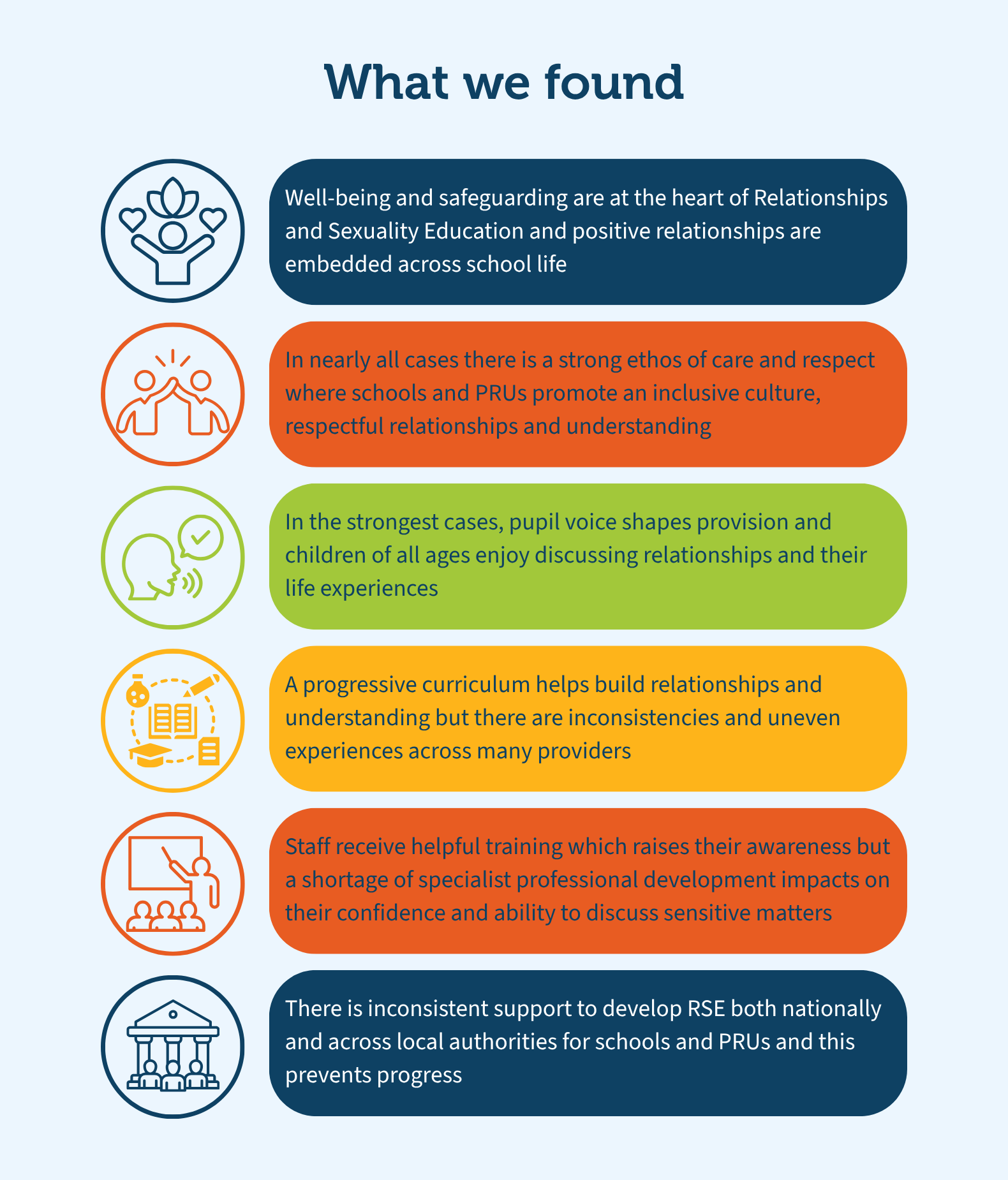
We talked to pupils and staff and observed work in 30 schools and pupil referral units (PRUs) across Wales to look at the quality and impact of relationships and sexuality education (RSE). We found that, in the schools and PRUs visited, senior and middle leaders demonstrated a strong moral commitment to promoting pupils’ well-being and healthy relationships as part of their whole school approach to mental and emotional health. In most of these schools and PRUs, leaders placed well-being at the centre of their strategic vision. They articulated clear values rooted in respect, kindness, understanding and inclusion and reflected these consistently in policies, behaviour systems and day‑to‑day practice. In many cases, leaders positioned RSE within a broader whole-school approach to well-being, safeguarding and inclusion rather than treating it solely as a discrete subject. Inspectors noted that established pastoral systems and responsive safeguarding arrangements supported this work effectively. Leaders worked closely with health professionals, police liaison officers and third-sector organisations to respond to emerging concerns, including misogyny, online exploitation, harmful attitudes to gender norms and unhealthy peer relationships. These partnerships strengthened schools’ capacity to respond to contextual risks. As a result of this strong practice, across most providers, nearly all pupils that we spoke to reported that they felt safe in school, valued and able to seek help when needed.
Many leaders used a suitable range of evidence to inform planning. This included safeguarding records, national and local well-being data, and findings from pupil voice activities. Most schools and PRUs had established appropriate mechanisms to capture pupil voice. In the majority of cases, pupils contributed to identifying priority topics and shaping aspects of provision. In the best examples, leaders used this insight to influence curriculum content and wider cultural initiatives, such as festivals and celebrations to promote diversity. However, in a minority of providers visited, leaders gathered pupils’ views only periodically and did not consider this information well enough to be able to embed it in long-term planning.
Although many leaders mapped RSE across year groups, only a few considered secure and coherent progression from ages 3 to 11 or from 3 to 16. Mapping typically identified where topics appeared but did not evaluate the depth or the sequence of learning. Collaboration between primary and secondary schools was not evident in many cases and this led to limited cumulative progression. Overall, although leaders had established strong pastoral foundations and a strong ethos of inclusivity, quality assurance and evaluation was generally at an early stage. Even where there were strong examples of leaders adapting curriculum content in response to emerging issues, too often they evaluated provision by checking coverage of topics rather than measuring impact on pupils’ knowledge, attitudes, and decision-making. Only a few providers evaluated the impact on pupils’ personal and social development systematically over time.
Most schools prioritised professional learning appropriately and recognised that effective RSE required teachers and support staff who were confident to teach this aspect of the curriculum. Staff had accessed a broad range of training linked to safeguarding, trauma-informed practice, mental health, and curriculum planning. Although this professional learning strengthened the interpersonal foundations necessary for effective RSE it did not normally lead to an increase in staff confidence in teaching more sensitive aspects of RSE. In many providers, designated leaders had undertaken targeted training and shared their learning with colleagues. Leaders also made productive use of external partnerships. School nurses, other health professionals, police officers and third-sector organisations contributed specialist expertise and supported staff development. Schools valued the continued involvement of school police officers despite changes to national funding arrangements.
Inspectors identified professional learning as a clear and consistent area for improvement across providers. Professional learning for teachers often focused on general well-being themes rather than subject-specific pedagogy. In order to provide good quality learning experiences in a safe and secure way for pupils’ age and stage, careful attention to pedagogical methodology is needed. Staff across all schools and PRUs reported lower confidence in teaching sexuality education, addressing misogyny and harmful gender norms, supporting gender-diverse pupils and using accurate terminology. This resulted in variation in the quality and depth of delivery of these sensitive themes. It also led to insufficient coverage, especially in Phase 3 (from age 11) which was also reported by pupils themselves. In addition, time, funding and capacity presented ongoing challenges for schools and PRUs. Leaders frequently held multiple responsibilities and lacked protected time to develop RSE strategically. Financial pressures limited access to specialist providers. In a minority of schools, over-reliance on external contributors reduced sustainability, limited opportunities to build internal expertise and often provided pupils with one-off or unrepeatable learning experiences.
Overall, we observed that provision for RSE supported pupils’ general personal development effectively in most schools and PRUs visited. Leaders and teachers fostered an inclusive culture successfully, with many providers promoting equality and diversity clearly and consistently. This led to most pupils speaking positively about feeling respected. RSE was integrated well within the wider curriculum and pastoral framework. Broadly, pupils benefitted from learning that was age‑appropriate and aligned with their developmental stage. Nevertheless, leaders did not always plan systematically for the inclusion of RSE within the wider curriculum. Overall, there was little coverage of topics such as sex, gender and sexuality. This depended heavily on individual staff confidence, their understanding of how to address sensitive topics and their ability to use the correct terminology.
In many schools, leaders designed broad and balanced curricula that revisited key themes. Typically, younger pupils in Phase 1 (from age 3) learned about love, kindness, and friendship. Pupils in Phase 2 (from age 7) explored equality, digital safety and healthy relationships. Older pupils in Years 10 and 11 (Phase 3) discussed topics such as consent, gender identity and abusive relationships. Cross-curricular links reinforced learning effectively in many cases. For example, pupils enjoyed exploring moral and social themes through literary texts and examined prejudice and propaganda in subjects within the humanities. These approaches helped pupils connect relationship learning to wider social understanding.
In most sessions across the age range, teachers, including teaching assistants working with younger pupils, encouraged discussion and reflection. In the primary phase, daily emotional check-ins supported pupils to express feelings openly. In the secondary phase, many teachers facilitated thoughtful discussions on pertinent issues. However, variability in staff confidence affected the depth and consistency of conversations in a minority of cases. Where staff confidence was lower, teachers relied heavily on structured schemes purchased by the school or one-off enrichment events provided by specialists. This practice limited progression in learning. Inclusion and representation of different groups also varied across the phases.
A noteworthy strength was how most schools and PRUs embedded positive messages about healthy relationships beyond formal learning sessions. Assemblies, behaviour support systems and restorative approaches reinforced expectations consistently, particularly when linked to the providers’ values and vision. Staff at all levels modelled respectful and friendly relationships which impacted positively on pupils’ attitudes to school and their appreciation of how staff supported them. Many older pupils demonstrated considerable empathy and maturity in discussion with inspectors, which reflected the extent of their positive engagement in RSE.
In order to improve the quality and impact of RSE in the future, schools and PRUs would benefit from depending less on expanding provision and more on deepening the learning, particularly around sensitive topics. In order to do this, leaders would need to strengthen progression from phase to phase and embed age-appropriate inclusive themes systematically through the curriculum. Professional learning for subject-specific pedagogy would support building staff confidence in addressing complex issues and result in pupils accessing deeper learning in critical areas as they move towards adulthood.