Responding to children’s interests and fascinations to enhance the learning
Quick links:
Information about the setting
Sunray Day Nursery is a bright, spacious, two–storey converted barn situated in the beautiful countryside surrounding Mold, North Wales. The setting is registered for 159 children from birth to 12 years. The setting is working towards the Welsh Active Offer and provides Early Entitlement Education.
The nursery benefits from its picturesque location and is fortunate to have extensive outdoor spaces that provide children with rich opportunities for exploration, discovery, and active play.
The nursery’s rural environment enables children to develop an appreciation of the natural world. Surrounded by open fields, children regularly observe local wildlife and farm animals, including sheep and cows that often graze nearby, enhancing their understanding of nature and the changing environment. The setting is a large, well-established nursery led by a dedicated proprietor and management team who are fully committed to continuous development. Their investment in maintaining high standards and improving provision is evident, and they provide strong support to room leaders and practitioners, fostering a positive and collaborative working environment that benefits both staff and children.
Context and background to the effective or innovative practice
Sunray Day Care Nursery Ltd supports each child to make progress through effective environments, engaging experiences and enabling adults.
Recent training has enhanced practitioners’ ability to observe children and identify their interests. This ensures children are fully engaged in activities. Leaders continue to support practitioners’ continuous professional development, arranging training opportunities in response to needs identified during staff supervision as well as regular mandatory training.
Description of nature of strategy or activity
Planning is centred around children’s views and interests. Children’s experiences are used as learning opportunities and are adapted to suit their individual stages of development. Children are actively involved with setting up activities, sharing ideas and taking ownership of environments. Practitioners support older children in completing questionnaires to ensure their views are included when planning provision. Children are encouraged to discuss what they like and dislike in each provision area and any other resources they feel could be added to these areas. For example, children showed interest in fairytales, so practitioners transformed the setting’s reading area into a faraway land, sparking imagination and curiosity. Practitioners follow a responsive planning approach, following the children’s interests during all sessions, encouraging curiosity, creative thinking and imagination. This approach is in line with the children’s developmental needs and activities are adapted throughout the day in line with their interests and ideas. Practitioners also ensure there are pre-planned experiences to ensure effective progression in learning. They undertake observations which highlight a child’s next steps.
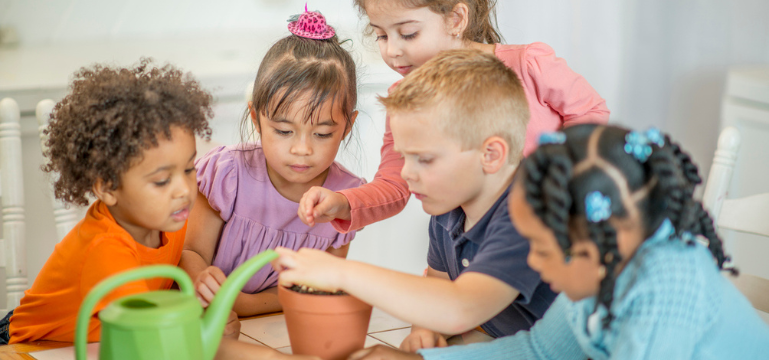
Practitioners also encourage parents to share their children’s experiences from home. This will often spark shared interests and new ideas that can be incorporated into the play and learning. For example, practitioners created a garden centre in the role play area following a child sharing pictures of their weekend trip. Practitioners enhanced this experience by planning a visit for the children to explore the plants and flowers. They bought flowers and had the opportunity to plant and care for them back at the setting.
An online app is used as a communication tool between the setting and home which allows parents to share photos of the children’s interests and adventures. Practitioners document children’s interests, and they are displayed within the learning environments. All staff use the information effectively to support children in their play. Following the children’s feedback, practitioners make regular changes to the provision areas. They created a larger home corner and construction area, as these were the main areas the children were keen to explore. They added further resources providing opportunities for the children to create during play. They also added ramps, reels and tyres for the children to access. Leaders also access grant funding to purchase new resources based on the children’s interests.
Resources are thoughtfully positioned to provide opportunities for children to transform and manipulate materials independently, such as grating chalks using cheese graters to create their own paint, fostering creativity and problem-solving skills. Practitioners skilfully balance support and independence, providing guidance when needed while allowing children the time and space to discover, investigate, and explore for themselves.
What impact has this work had on provision and children’s standards?
Practitioners demonstrate passion and commitment in their roles, working collaboratively and inspiring each other to regularly adapt and enhance the learning environment in line with children’s interests and fascinations. These changes create stimulating opportunities that spark children’s curiosity, encourage exploration, and promote ongoing engagement in learning. As a result, the progress in learning has risen across all areas of the curriculum.
How have you shared your good practice?
The setting recently hosted a network meeting of practitioners who support education for funded non-maintained settings in Flintshire. The setting also hosts regular networking events for NDNA members within Flintshire.