Effective opportunities for pupils to take a prominent role in leading
Quick links:
Information about the school
Ysgol y Strade is a bilingual comprehensive school that provides education for pupils aged 11-18 in Carmarthenshire local authority. The school is situated close to the coast, on the west side of Llanelli. There are 1,270 pupils on roll with 182 pupils in the sixth form. The school’s catchment area extends along the south-east coast of Carmarthenshire, from Fforest and Hendy in the east, to Kidwelly in the west. Most pupils come from Llanelli and the surrounding villages.
The headteacher was appointed to the post in September 2017. The leadership team also includes a deputy headteacher and four assistant headteachers.
Context and background to the effective or innovative practice
The school places a strong emphasis on developing pupils as confident individuals who contribute actively to the life of the school and their wider community as valuable members of the Strade family. Within this vision, pupil leadership is a central element of the school’s culture, with clear structures which ensure authentic opportunities for pupils to take part in decision-making and drive whole-school developments.
Over time, the school’s leaders have developed a comprehensive system of leadership structures for pupils which extend beyond traditional consultation activities. This approach enables pupils to lead initiatives, jointly produce policies and undertake specific responsibilities which have a direct effect on pupils’ learning experiences and well-being across the school.
This structure is embedded in the work of the school council, ‘Llais y Strade’, and its thematic sub‑committees, which focus on priority areas such as the environment, Welshness, facilities and well-being. Through this work, pupils contribute regularly to whole-school priorities and develop as active leaders within the school community.
Description of nature of strategy or activity
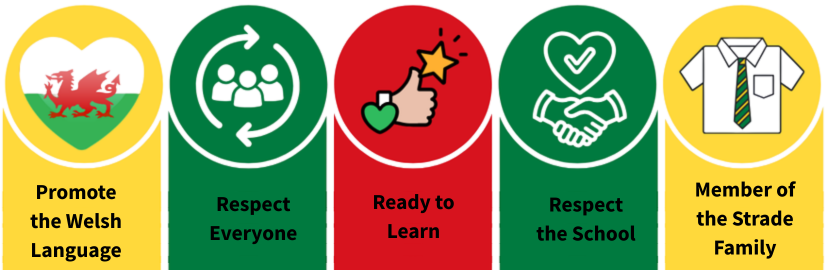
The school council’s work has led to jointly producing Siarter y Dysgwyr, which summarises the school’s values and expectations and is now visible in all classrooms. This charter provides a consistent framework for promoting high standards of behaviour, respect and responsibility across the school.
Members of the school council also present pupils’ views regularly to the governing body, ensuring that pupils make a direct contribution to discussions and decisions at a whole-school level. Pupils are supported by link staff who facilitate the work and support them to plan and implement initiatives effectively.
In addition to the work of the school council, the school provides a wide range of further opportunities for pupils to develop their leadership skills by taking part in whole-school initiatives across areas such as Welshness, well-being and sports. Pupils contribute actively to organising whole-school events, leading campaigns to raise awareness and supporting younger pupils through purposeful mentoring roles. For example, Sports Ambassadors and members of the Year 7-9 Well-being and Sports Committee lead activities for the cluster’s primary schools and contribute to well-being and anti-bullying initiatives. Pupils also lead science and technology initiatives, such as the Racing Club and robot building projects, which develop their co-operation and problem-solving skills in authentic contexts.
Sixth-form pupils play an important leading role in co-ordinating the work of the whole-school committees that promote charity work, Welshness, health and well-being, and communication. Through this work, they organise whole-school events, lead community initiatives and contribute to developing opportunities for other pupils to participate in school life. For example, the Charity Committee organises an annual Easter egg appeal to collect donations for a local food bank, strengthening pupils’ awareness of the needs of the local community. They also lead initiatives such as the school radio station, Sain y Sosban, which contributes weekly to the morning well‑being sessions and supports weekly mentoring arrangements for Year 7 pupils. These opportunities enable older pupils to put their stamp on the school’s developments and develop as confident leaders who contribute actively to the Strade community.
What impact has this work had on provision and learners’ standards?
Regular opportunities for pupils to play a leading role in school life have contributed to a culture where pupils feel that their opinions are valued and have a meaningful influence on whole-school development. As a result, pupils participate actively in initiatives that improve the school environment, well-being provision and opportunities to promote Welshness. For example, pupils’ work on environmental issues led to the introduction of a whole-school campaign to improve recycling arrangements and reduce litter on the site, along with changes to the canteen arrangements to reduce the use of single-use plastic. These changes have contributed to a clear improvement in the school’s environment.
Pupils have also played a leading role in promoting Welshness by establishing social opportunities to use the Welsh language and contribute to changes to the arrangements for the whole-school Eisteddfod to ensures wider participation across all year groups. Initiatives such as the school radio station, Sain y Sosban, support the ability of older pupils to share positive messages and promote contemporary Welsh language music across the school. All of this has strengthened the sense of belonging and identity among pupils.
Pupils’ contribution to well-being initiatives has also led to the development of anti-bullying campaigns and influenced the content of provision for whole-school well-being days. This has supported the development of a supportive learning environment that responds effectively to pupils’ needs.
Wider leadership opportunities through mentoring younger pupils, leading sports and eco initiatives and contributing to scientific activities have enabled pupils to develop their confidence, communication skills and organisational skills. As a result, pupils develop as responsible individuals who contribute actively to the life of the school and the wider community.
How have you shared your good practice?
The school shares pupils’ leadership work regularly through presentations to registration classes, whole-school assemblies and communication through the school’s digital platforms and the Straeon o’r Strade newsletter at the end of each term. This ensures that all pupils are aware of the impact of the work of the school council and committees and are given opportunities to contribute to their priorities.
Pupils also share their work by sharing whole-school campaigns to raise awareness and by presenting their ideas and priorities regularly to the governing body, thereby strengthening their role as active contributors to the school’s developments.
The school also provides opportunities for pupils to lead initiatives jointly with external organisations and community partners, such as local charities and community organisations, expanding the impact of their work beyond the school and strengthening their role as active citizens within their community.